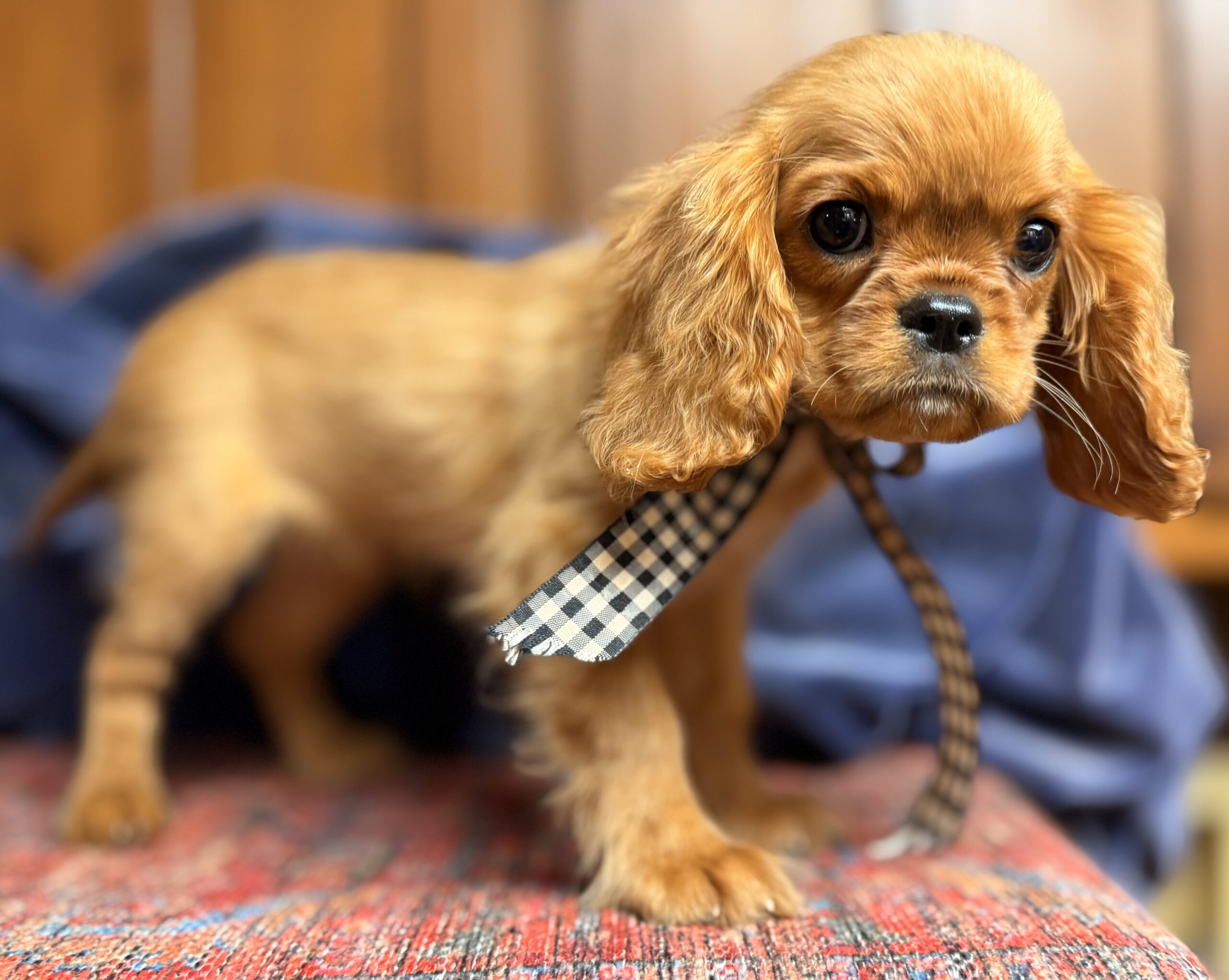

What age Cavalier should I buy?
The CKCSC, USA Code of Ethics prohibits a puppy leaving for its new home prior to eight weeks of age and recommends ten to twelve weeks as the appropriate age for transfer. Cavalier puppies are very slow to mature and benefit from staying with their mothers and littermates longer than many other breeds.
A Cavalier nine to twelve months old is a good choice for a family with children under the age of five. Cavaliers have a long puppyhood and will still be puppies at this age!
Many people find that an older Cavalier is ideal. There are many advantages, among them that the dog is already housebroken and beyond the puppy chewing stage. Any concern that such a dog will never bond as strongly as one obtained as a young puppy is unfounded.
Cavaliers of any age will bond with their new owners. “Love the one you’re with” is the Cavalier motto.
Adjustment Tips: Young vs. Older Cavalier Puppies
At Lizmere, we match families with Cavalier King Charles Spaniel puppies at different ages—some as young as 10 weeks, and others a bit older. Each age brings unique benefits and needs, especially when it comes to transitioning into a new home.
10-Week-Old Puppies: Eager and Adaptable
Puppies placed at this age are in their early social development stage. Everything is new and exciting to them, and they tend to bond quickly with their new family members. Their flexibility makes the transition relatively easy, and they often settle into their new homes within just a few days.
Older Puppies: Thoughtful and Bonded
When placing an older puppy (typically 4 months and up), we remind new owners that these pups may take a little more time to adjust. They’ve had more life experience, have developed attachments with their littermates and caregivers, and may be more observant or reserved at first.
This is completely normal and simply a sign of emotional maturity. With time and trust, their loving and playful nature always shines through.
What to Expect from an Older Puppy
- May be quieter or shy at first
- Needs time to observe and feel safe
- Opens up gradually—often in just a few days or weeks
How to Support the Transition
- Give them space and time – Let them adjust at their pace
- Maintain a gentle routine – Predictability helps them feel secure
- Use quiet affection and encouragement – Cavaliers respond beautifully to love and patience
The Result? A Deep Bond for Life
Older Cavalier puppies often form exceptionally strong connections with their new families once they’ve had time to trust and settle in. The initial adjustment period is short-lived compared to the lifelong loyalty and love you’ll receive in return.
Questions about puppy ages or personality fit?
We’re happy to help guide you to the right match.
Are Cavaliers good guard dogs?
No. While Cavaliers will alert their owners to the arrival of someone new, they seem to regard all strangers as friends they haven’t met yet. Although a noisy greeting might be enough to ward off a prowler, it is difficult to picture anyone being scared off by a Cavalier.
How are Cavaliers with other pets in the household?
Cavaliers are the ultimate groupies and are usually delighted to have the company of cats and dogs of any size. If you have a large dog, you will need to watch your Cavalier puppy carefully while it is small. Because Cavaliers are spaniels with a strong sporting instinct, they should be watched closely around birds and other small animals as well. Many Cavalier owners report that they have trained their dogs to live happily with hamsters, gerbils, rabbits, and the like. (In households where no one is home during the day of, the companionship of another dog or a cat is highly recommended.)
Can my Cavalier be left outdoors while I’m at work every day?
Cavaliers are indoor dogs. While they are sturdy and hardy and can thrive in both cold and hot climates, they are not dogs to be left outdoors. Leaving a Cavalier outdoors when no one is home would put the dog at great risk of being stolen. Your Cavalier should have a safe place in your house where it may be left during the day. The younger the Cavalier, the more restricted the area should be.
Do Cavaliers travel well?
People who travel find it easy and pleasant to take their Cavaliers along. Their strong desire to be with their owners makes them willing travelers. Their size and personality contribute to their welcome at dogs-allowed hotels, marinas, and campgrounds.
What kind of grooming do Cavaliers require?
The Cavalier does require regular grooming. A great deal of time and effort is not necessary if the dog is brushed and combed thoroughly at least once a week. Knots and tangles are kept to a minimum if the Cavalier is free of parasites and combed regularly. Ears need particular attention and should be checked and given a quick combing every few days, daily in shedding season.
Cavaliers do shed, particularly in spring and fall, but a little all the time. Their nails should be clipped and the hair between their pads trimmed once a month. No other trimming is necessary (or allowed) in the show ring.
Cavaliers are naturally clean dogs. Because too much bathing dries out the skin and haircoat, they should not be bathed more than once a week. All knots and tangles should be brushed out before a Cavalier is bathed. Many owners find that bathing their pets every two months is quite adequate.
Are Cavaliers good with senior adults?
Retirees and empty nesters find the companionship, temperament, small size, and easy maintenance of Cavaliers ideal. Women have mentioned that a Cavalier resting on her lap or in the crook of her arm is almost as peaceful as holding a sleeping infant. And more than one senior citizen has received two invitations for a cocktail party or other get-together, one addressed to the senior and the other to his or her Cavalier.
Are Cavaliers good with children?
Cavaliers love to interact with their owners and enjoy activity and play, making them especially close friends and confidants for children. Cavaliers are excellent with children, but the age of the children is an important factor in choosing a puppy. Because Cavalier puppies are so small, many breeders will not sell young puppies to families with children under the age of five. An older puppy or adult dog will be more suitable for such families. All children, of course, need supervision to ensure they do not hurt the dog.
How much exercise do Cavaliers require?
Cavaliers need either a moderate size fenced-in yard in which to run, or a minimum of one good walk each day (in addition to potty walks). If their owners want walking companions, Cavaliers can build up over time to much longer walks. Regular exercise is very important for a Cavalier’s heart. Even older Cavaliers should be encouraged to go up and down stairs.
What is an Umbilical Hernia?
Umbilical hernias are quite common in the breed and seldom need repair. Though many breeders persist in believing that they are caused by the bitch pulling too hard on the cord at birth, evidence supports the idea that umbilical hernias are also genetic.
Cavaliers with umbilical hernias are used for breeding since the problem is not a major health concern, and there are many other more serious genetic health issues to deal with, before these normally harmless hernias become an issue. This type of hernia is most frequently due to the umbilical ring not closing immediately after birth.
Sometimes a little fatty tissue is trapped on the outside of the abdomen after the ring closes, leaving a small, hard protrusion. If the protrusion cannot be pushed back up into the abdomen, the hernia is referred to as non-reducible, and it is of no concern, either for health, show, or breeding purposes. If the fatty protrusion continues to be soft and is able to be pushed back up into the abdomen, it is called a reducible hernia. Surgery may be advisable if the abdominal ring has not closed by adulthood, particularly in the case of a bitch that is going to be used for breeding, but again, this is infrequent. It’s a very simple procedure for your vet to take care of at the time of spay/neuter.
What is the instinct of a Cavalier King Charles Spaniel?
Cavalier King Charles Spaniels are playful, agreeable, patient, and highly affectionate. They enjoy spending time with their owners, other dogs and aren’t intimidated by much larger dogs. As spaniels, they have a hunting instinct and will chase after balls, birds, and cars.